Search Nature Watch

Monday, September 5, 2022

Late Summer Skimmers

The quiet waters of a pond like this make great dragonfly habitat

Dragonflies are conspicuous visitors to various bodies of water, especially in the warmer months of the year.    These visitors include members of the largest family of dragonflies, the Libellulidae, otherwise known as the skimmers. Skimmers can be large and colorful, some with distinctive wing patterns, and are often seen perching on twigs and branches.  In late summer, especially after summer rains, some locally common but not often observed species can be found around newly refilled ponds, including the Gray-waisted Skimmer (Cannaphila insularis), Needham’s Skimmer (Libellula needhami), and Slaty Skimmer (Libellula incesta).  

Found in shady or marshy ponds, typically with tall reeds or cattails, the male Gray-waisted Skimmer has greenish-blue eyes, a white face in front and metallic blue on top, and a dark brown or black thorax divided by several pale stripes.  Its abdomen is pruinose gray on the front half and black on the back half, and its wings are clear with extreme dark only at the tips.  Females and juveniles have a yellow-orange abdomen marked with dark brown or black.  Gray-waisted Skimmers are often found perching in the shade at the tips of vegetation, with their abdomen held nearly parallel to the perch.

Gray-waisted Skimmer, male

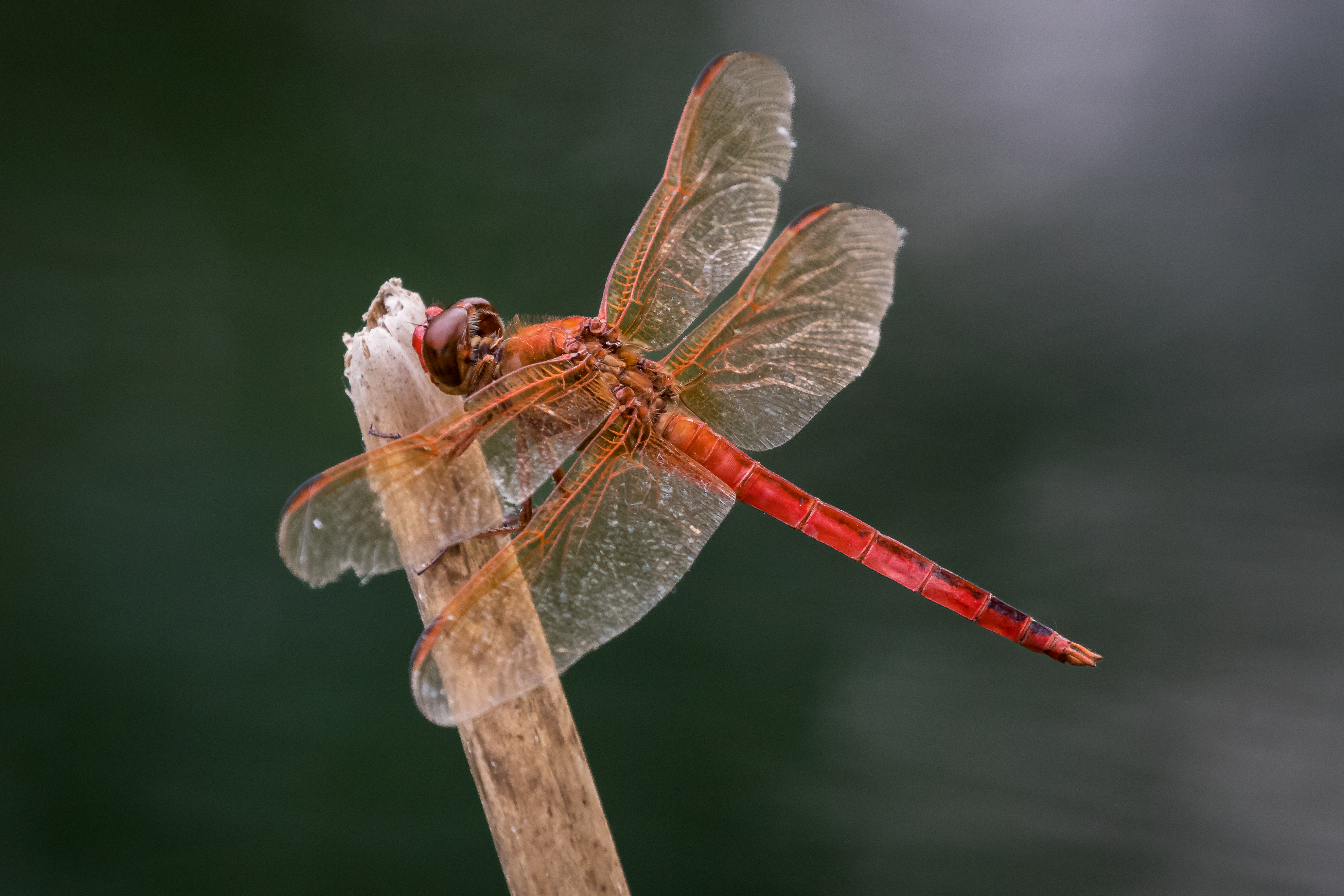
The male Needham’s Skimmer has reddish-orange eyes and face, and a thorax than is orange in front and paler or more tannish on the sides. Its abdomen is reddish-orange with a dark dorsal stripe down the length, and its orange wings are somewhat darker along the leading edge.  Females and juveniles have brown eyes and faces, a yellowish-brown thorax, and their abdomens are yellow with a dark stripe running down the middle.  Needham’s Skimmers are typically found perching low on vegetation or overhanging the water’s edge.

Needham's Skimmer, male

Most often seen around marshy forest ponds, the male Slaty Skimmer has dark eyes and a metallic blue or violet face, and both the thorax and abdomen have an overall slaty-blue pruinescence.  The wings are typically clear, but can have a pale bluish stripe along the leading edge.  Females and juveniles have red-over-gray eyes and a pale face, a cream-colored thorax with broad dark shoulder stripes, and a black abdomen with yellowish-orange markings. Females also have more prominent dark wing tips and develop a pale pruinosity at maturity.  Males perch on top of tall grasses and sticks most often in sunlit areas.

Slaty Skimmer, male

Check out your local pond or body of water before the end of September, and you just might be rewarded with a sighting of these less common, late summer skimmers!

Wednesday, August 3, 2022

Beat the Heat


Flame Acanthus is a hot weather bloomer.

The heat of the Texas summer is enough to make everything wilt, but there are some native plant species that truly thrive in these unrelenting temperatures and drought-stricken conditions.  These plants include Turk’s Cap (Malvaviscus arboreus var. drummondii), Flame Acanthus (Anisacanthus quadrifidus var. wrightii), Violet Ruellia (Ruellia nudiflora), and Western Ironweed (Vernonia baldwinii).

Turk’s Cap, also known as Drummond’s Turk’s Cap, Wax Mallow, Mexican Apple, Manzanita, and Sleeping Hibiscus, is a spreading shrub to 4 feet high, with large green leaves on upright stems.  Bright red flowers atop the stems are twisted into a whorl from which protrude red stamens.  These flowers are a natural source of nectar for hummingbirds and butterflies, and it is a host plant for the Turk’s-cap White-Skipper butterfly.  The resulting fruit is red and marble-sized, and edible for animals and humans alike. Turk’s Cap is the perfect plant to grow under trees that tend to shade out non-native turf grasses, as they form a natural cover and provide much needed color from May all the way to November.


Turk's Cap

Turk's Cap fruit

Turk's-cap White-Skipper

An airy, spreading shrub to 5 feet tall, Flame Acanthus has tender lance-shaped green leaves and tubular red flowers that open to 4 lobes and occur along terminal spikes.  Blooming in full sun from June to October, it attracts both hummingbirds and butterflies, and is also known as Hummingbird Bush, Wright’s Acanthus, and Mexican Flame.  It is the host plant for the Crimson Patch, Elada Checkerspot, and Texan Crescent butterflies. The fruit is a small, hood-shaped capsule with seeds attached to a hooked stalk that helps to eject them from the capsule when it dries and splits open.

Flame Acanthus

Flame Acanthus seed capsule

Crimson Patch

Violet Ruellia is an erect herb that is woody at the base with few branches, growing to 2 feet tall.  The dark green leaves are oval-shaped, and the trumpet-shaped violet flowers at the ends of stalks open at sunrise and fall from the plant in early afternoon, from March all the way through October. Also called Wild Petunia, it does well in sunny areas and is a host plant for the Common Buckeye butterfly.  One of its’ subspecies is a host plant for the Malachite butterfly, a south Texas species rarely seen in central Texas.

Violet Ruellia

Common Buckeye

Often stout and forming colonies 5 feet high, Western Ironweed has hairy unbranched stems, large green leaves with serrated edges, and loose clusters of bright purple blooms at the apex of each stem.  From July to the first frost, these fuzzy blooms provide nectar for various types of pollinating insects and the seeds nourish several species of birds.  Also called Baldwin’s Ironweed, it is the host plant for the Parthenice Tiger Moth.  While this species’ growth can be aggressive, it flourishes if allowed to spread in larger, open, sunny areas.

Western Ironweed

These native species can (and often should) be pruned back in winter as they can get too leggy.  They have low water needs once established, and can tolerate hot temperatures and still continue to bloom.  They are the perfect plants to beat the heat, benefit our local wildlife, and provide much needed color in your own native summer garden!


Saturday, June 25, 2022

Summertime Skimmers

The female Comanche Skimmer looks very different from the male (pictured below).

The heat of the summer is often a good time to search for dragonflies, specifically the skimmers, which comprise the largest family of dragonflies.  They are generally the most obvious, too, as they are frequently seen around ponds lakes, and streams, and perch conspicuously on twigs, bushes, and branches. 

Skimmers are often large and colorful with distinctive wing patterns, and many species of skimmers are sexually dimorphic, meaning the males and females of the same species are different in appearance.  Males frequently develop pruinescence or exhibit a frosty or dusty-looking coating when mature, while most females have little to no pruinescence at maturity.  In our area, some of the less common species include the Gray-waisted Skimmer (Cannaphila insularis), Checkered Setwing (Dythemis fugax), Needham’s Skimmer (Libellula needhami), and Comanche Skimmer (Libellula comanche).

The male Gray-waisted Skimmer has greenish-blue eyes, a face that is white in front and metallic blue on top, and a dark thorax divided by several pale stripes.  The wings are clear except for dark extreme tips, and the abdomen is black on the back half and pruinose gray or white on the front half, which gives rise to its common name.  Females and juveniles have reddish-brown over blue-gray eyes, and the abdomen is yellow or orange with brown or black in between segments.  These skimmers prefer shady, marshy ponds, lakes, and streams, particularly those with cattails or tall reeds, and are on the wing from June to September.

Gray-waisted Skimmer, male

From mid-April to mid-December, you can find Checkered Setwings, as they are widely distributed and sometimes locally abundant.  The male has bright red eyes and face, a reddish-brown thorax with obscured dark stripes, and clear wings except for a large patch of brown coloring near the base.  The abdomen is black with two pairs of pale streaks at the base of each segment, giving it a checkered black-and-white appearance. Females and juveniles are similar, but often have a paler face and a pale thorax with narrow dark stripes.  These setwings favor slow-flowing streams and rivers, ponds, and generally open areas with tall vegetation but little canopy.

Checkered Setwing, female

Male Needham’s Skimmers have reddish-orange eyes and face, thorax orange in front and paler on sides, and wings that have orange veins along the leading edge and clear along the trailing edge, giving them a somewhat bicolored appearance.  The abdomen is reddish-orange with a dark dorsal stripe down its length.  Females and juveniles have brown eyes and a pale face, yellowish thorax, and abdomen yellow throughout with the same dark dorsal stripe as the male.  On the wing from late April to early October, this skimmer prefers marshy ponds and lakes, and is often found perching low on vegetation surrounding or overhanging the water.

Needham's Skimmer, male

Comanche Skimmers can be found on the wing from May to mid-October, around springs, seeps, and sluggish areas of clear-running streams.  The male has aqua-blue eyes, a white face, and both thorax and abdomen with a uniformly blue pruinescence.  The wings are clear but for a bi-colored black and white pterostigma, a group of specialized cells in the leading edge of the wing towards the wing tip.  Females and juveniles have reddish-brown to pale blue eyes and a pale face, a cream-colored thorax with broad dark shoulder stripes, and a mostly yellow abdomen with a broad dark dorsal stripe running down the length.

Comanche Skimmer, male

Brave the heat during these hot months of the year and take a walk around a pond, stroll along a stream, or be on the lookout when on the lake, because you just might see one of these interesting summertime skimmers!


Wednesday, June 1, 2022

Undervalued Vines

  The uncommon Plateau Milkvine is often mistaken
for the more common Pearl Milkvine (above).

Every species of native plant has its purpose, and while many are valued by humans for their fragrant flowers and foliage, those that are valued for their role in keeping the earth’s nutrient cycles intact should be regarded as having the highest value.  Those nutrient cycles need to be protected through plant preservation or restoration, as they are what provides nourishment for the lifecycles of our native wildlife and protects the health of our ecosystems.

Even among those folks who are familiar with many native plants that perform this role, there are some little-known species that are often overlooked and under appreciated.  In Central Texas, there are a few species of vines in the Milkweed family that many fail to notice, including Star Milkvine (Matelea biflora), Plateau Milkvine (Matelea edwardsensis), and Bearded Swallow-wort (Cynanchum barbigerum).  

Star Milkvine, also called Purple Milkweed Vine, is a relatively common vine that grows in pastures, prairies, and other open ground, usually in chalky soil throughout Central and North Texas.  This small, trailing vine to 2 feet has five-petaled, star-shaped, deep purplish-brown flowers that are 0.5 inches wide.  Blooming from March to June, the flowers occur in pairs along the trailing stems that radiate from a central rootstock, and arise from the axils of the opposite, triangular leaves.  The flowers, leaves, and stems are all quite hairy, as is true of many members of the Milkweed family.  Its habit is to grow low among grasses, often in areas that are mowed, so it is frequently passed over by humans, but is a useful host plant for Queen and Soldier butterflies and a nectar plant for several species of bees.

Star Milkvine has low-growing stems that radiate out
from a central rootstock.

The unusual flowers of Star Milkvine occur in pairs.

Soldier

Sometimes mistaken for the more common Pearl Milkvine, Plateau Milkvine is a vine to 3 feet that is endemic only to the Edwards Plateau of Central Texas.  This uncommon vine shares the same twining habit of Pearl Milkvine, but its leaves, while similar, generally have a somewhat wavy edge, and its flowers are bell-shaped instead of flat. Additionally, its 0.7 inch wide greenish-white flowers do not have a pearl center, and its petals are not solely reticulate-patterned, having parallel veins in their lower halves and centers, and reticulate or networked veins only on the edges or margins.  Blooming in April and May, this vine can be found on gravelly soils in open woodlands, often climbing on other plants, and is a native host plant for Queen butterflies.  Due to indiscriminate land clearing, this plant is listed as ‘vulnerable’ in terms of its conservation status in Texas.

Plateau Milkvine is a rare cousin to Pearl Milkvine.

The flowers of Plateau Milkvine distinguish it
from Pearl Milkvine.

Queen

Growing up to 8 feet long, Bearded Swallow-wort, also called Thicket Threadvine and Aphid Vine, is a delicate vine that climbs on shrubs and small trees in open woodlands, in thickets, and along roadsides and fencerows in the Edwards Plateau and South Texas. It has small glossy lance-shaped, opposite leaves to 2 inches long, and from March to August, tiny creamy-white flowers appear in loose clusters from the leaf axils.  These flowers are 0.25 inches wide, bell-shaped, and have five distinctively hairy or ‘bearded’ recurved petals.  Five similar species in this genus are present in Texas, but this is the only one with ‘bearded’ flower petals.  Aphids are often found on this plant, giving rise to one of its other common names, and it is the host plant for the Obscure Sphinx Moth (Erinnyis obscura).

Bearded Swallow-wort is a rather delicate climbing vine.

The fringed or 'bearded' flowers
of Bearded Swallow-wort.

Obscure Sphinx

Whether it is due to their scarcity or diminutive stature, it is easy to miss these vines.  While they might be undervalued by humans, they are quite valuable to our native wildlife!


Monday, April 25, 2022

Introduced Invaders


Closeup of a Bastard Cabbage bloom

Spring brings new growth to all types of plants, including those species known as non-native invasives.  Non-native plants, also called exotics, are defined as plants ‘growing in a place that is not the region where they naturally grow’, and invasive plants are defined as plants that are ‘both non-native and able to establish on many sites by growing quickly and spreading to the point of disrupting native a plant community or ecosystem’.  

While plants that are non-native or invasive can be problematic, when a plant is both non-native and invasive, it can quickly outcompete native plants.  These invaders can produce copious amounts of seed easily transmitted by wind, water, or birds, thrive on poor or disturbed soils through aggressive root systems, have an early growth season or produce growth-inhibiting chemicals, and ultimately disrupt natural nutrient cycles of wildlife.  

In Central Texas, the species that cause the most harm to the local environment include Ligustrum (Ligustrum sp.), Nandina (Nadina domestica), Chinaberry (Melia azedarach), Chinese Tallow (Triadica sebifera), Bastard Cabbage (Rapistrum rugosum), and Japanese Honeysuckle (Lonicera japonica).  Most of these species have been introduced to the United States via the nursery trade as ornamentals, and unfortunately many are still sold today.

Ligustrum or Glossy Privet

Ligustrum or Glossy Privet, native to China, Japan, and Korea, is an invader of roadsides, thickets, open woodlands, and disturbed areas.  This evergreen tree to 40 feet has simple green, glossy pointed leaves.  It is widely cultivated and frequently escapes to invade and dominate the woodland understory, as its abundant purple-blue fruits are easily spread by birds and other animals.

Nandina or Heavenly Bamboo

Nandina or Heavenly Bamboo, native to China and Japan, is an invader of landscapes, roadsides, and other cultivated areas.  This erect, multi-stemmed shrub to 8 feet has compound green leaves to 12 inches long that are tinged with red in winter.  It spreads by escaping cultivation through underground root sprouts and animal-dispersed seeds, and quickly forms a colony.  Additionally, its shiny red fruits are toxic to small children, pets, and some grazing animals.

Chinaberry

Chinaberry, native to parts of Asia, is an invader of roadsides, thickets, open woodlands, and disturbed areas.  This deciduous tree grows up to 50 feet and has compound green leaves to 24 inches long.  Lavender blooms distinguish it from the similar but native Western Soapberry (Sapindus drummondii), which has white blooms.  It spreads on site via fast-growing root sprouts and over longer distances via bird-dispersed seeds from its golden-yellow fruits.

Chinese Tallow

Chinese Tallow, native to China and Japan, is an invader of cultivated landscapes and other moist areas.  A deciduous tree that grows to 60 feet, it has diamond-shaped leaves with elongated tips that turn orange-red in fall.  It reaches reproductive age in as little as three years, producing prolific amounts of seed that is readily transported by birds and water.  It is difficult to eradicate once established, and can effectively transform a native habitat into a monoculture.

Bastard Cabbage

Bastard Cabbage, also called Common Giant Mustard and Turnipweed, and native to southern Europe, northern Africa, and western Asia, is an invader of meadows, fields, roadsides, and other disturbed areas.  This many-branched herb grows to 5 feet, with clustered of small lemon-colored flowers at the tips of branches.  Its seeds germinate early in spring, quickly covering the ground with a dense blanket of leafy rosettes that block sunlight from reaching seedlings of native plants.  It reseeds rapidly and forms large monocultures.

Japanese Honeysuckle

Japanese Honeysuckle, native to Japan, is an invader of thickets on disturbed floodplains, creeks, and river banks.  This climbing, sprawling vine grows to 80 feet, with simple oval leaves and tubular white flowers that turn butter-yellow as they age.  Choking out other species by girdling or by blocking out sunlight through overgrowth, its plentiful seeds are easily dispersed by birds and other wildlife.  It is not to be confused with the native, much less aggressive White Bush Honeysuckle (L. albiflora). 

Replacing these non-native invasive plants with native plants help restore natural habitat, preserve and produce much-needed soil, protect fragile waterways from erosion, and as a result, keep vital nutrient cycles intact for all forms of wildlife.  Natives are already adapted to our soils and climate so they require little to get established, are naturally hardy and disease-free, and they provide food, shelter, and places to raise young for local insects (especially pollinators), birds, and other wildlife.  Natives are also a beautiful reminder of the unique natural heritage of Texas, so please consider to replacing your non-native invasive plants with natives today.  Once established, you’ll be amazed at how they bring your landscape to life!

INVADER                                NATIVE REPLACEMENT(S) - some ideas...

Ligustrum species                    Escarpment Black Cherry, Mexican Plum

Nandina                                    Yaupon, Possumhaw, Rusty Blackhaw Viburnum, Sumacs

Chinaberry                                Western Soapberry, Oaks, Redbud, Mexican Buckeye

Chinese Tallow                          American Sycamore, Black Willow, Texas Ash

Bastard Cabbage                      Mistflowers, Salvias, Sages

Japanese Honeysuckle            White Bush Honeysuckle, Coral Honeysuckle


Monday, March 28, 2022

Color Changers


Green Anole, Anolis carolinensis

Native to North America and most abundant from the Carolinas south to Florida, along the Gulf Coast, and as far west as the Texas Hill Country, the Green Anole (Anolis carolinensis) is a small to medium sized lizard with a long, pointed head, slender body, long tail, and toes with adhesive pads that facilitate climbing.  Arboreal in nature, it can also be seen on the ground and in areas with shrubs and vines at the edge of our moist forests.

Males are typically 15% larger than females, from 4.9 to 8 inches long, with about 65% of that length being tail. Males have a dewlap or throat fan that is three times the size of the females and is strawberry-red, while the females’ dewlap ranges from white to light pink.  Unlike males, females also have a prominent white stripe that runs along their spine.

Male Green Anole with dewlap extended

Strongly territorial, males will fight other males to defend their territory, and have even been known to fight their own reflection in mirrored glass. When a male sees a rival, he will compress his body, extend his dewlap, inflate a dorsal ridge, and bob his head to chase off the intruder.  If that doesn’t work, they will fight, especially during mating season. A male’s territory typically includes two to three females, and he will court a female by extending his dewlap and bobbing up and down, mimicking a push-up. 

Breeding begins in April and ends in late September, with females laying their first clutch of one or two eggs about a month later.  Females can produce an egg every two weeks during mating season, up to about ten eggs, and they are buried in a shallow depression in soft soil or leaf litter.  Eggs are incubated by the heat of the sun, and hatch in five to seven weeks, with the hatchlings left to fend for themselves.

What is most intriguing about these lizards is their ability to change color from bright lime green to dark brown, and while often called ‘American chameleons’, they are not true chameleons.  Their ability to change color is a result of three layers of pigment cells or chromatophores.  The first is the xanthophores which is responsible for yellow pigmentation, the second is cyanophores responsible for blue pigmentation, and the third is melanophores responsible for brown and black pigmentation.

Male Green Anole, brown color form

If one of the chromatophores is lacking due to genetics, color mutations can form, but are extremely rare in the wild. Blue-phased green anoles lack xanthophores, and yellow-phased green anoles lack cyanophores.  These color exceptions rarely live long, as they don’t provide the camouflage the green color does, which is highly useful in hiding from predators and hunting down prey.

Several factors contribute to the anole changing its color, including its mood, stress level, activity level, and even social signals such as displaying dominance.  Although claimed, evidence does not support color change due to camouflage or a response to background color, and it is even less clear if the color change is in response to temperature.  When stressed, during a fight for example, the skin behind their eyes may turn black and form postocular spots that resemble a small black mask.  

Regardless of the reason, no other lizard species in Texas is capable of such extensive color change.  With populations existing in even the largest of cities, these color changers are a fascinating part of our suburban landscape! 


Thursday, February 17, 2022

Hummingbird Homecoming


Hummingbird feeders are busy during spring migration!

Early spring marks the beginning of several natural events, and one of the most welcome is the return of hummingbirds to central Texas.  While the number of hummingbirds migrating north in the spring is only about half of those migrating north in the fall (as the fall migration includes all immature birds that hatched in the summer as well as surviving adults), spring migration for these tiny birds is nonetheless an incredible feat.

Most scientists believe that the lengthening of daylight hours triggers the journey north, and evidence exists that hummingbirds follow a different route in the spring versus the fall.  While they follow the Texas coast south in the fall, presumably to avoid hurricanes in the Gulf of Mexico, in the spring they travel north hundreds of miles non-stop directly over the gulf’s calmer waters. 

Hummingbird feeders, filled with a clear solution (no red dye) of one-part white table sugar to four-parts water, should be placed out in early March.  Records show that the migrating hummers start arriving in our area at that time.  While these migrants can include more northern species that are just passing through, they mainly include the arrival of species that breed in our area, such as the Black-chinned Hummingbird (Archilochus alexandri) and the Ruby-throated Hummingbird (Archilochus colubris).

Black-chinned Hummingbird, male

Measuring a mere three and one-half inches long with a three and three-quarter-inch wing span, the Black-chinned hummingbird weighs only three to three and one-half grams, which is about equivalent to the weight of a dime plus a dollar bill. The male is dull metallic green above, gray below, black on the chin and upper throat, with an iridescent violet lower throat known as a gorget (pronounced gore-jet). The female lacks the characteristic coloring on the chin, upper throat, and lower throat.  Ruby-throated hummingbirds are also only about three and one-half inches long with the adult male having a black upper chin and ruby-red gorget, and they are a more eastern species with Austin being the westernmost border of their range. 

Ruby-throated Hummingbird, male

Like all hummingbirds, nectar serves as a main food source, fueling the tiny bird’s extreme metabolism.  These hummingbirds feed on several species of blooming plants, most notably native penstemons, agaves, salvias, sages, and honeysuckles.  While artificial feeders supplement their diet, they also prey on insects and spiders, particularly during nesting season, which gives them the dietary fat and protein necessary to breed.

The hummingbird’s unique skeletal structure allows them to fly forwards, backwards, sideways, and even on their backs!  This requires a wingbeat frequency of about 50 beats per second, and massive muscles that make up a third of their tiny body weight.  While the males perform an elaborate flight display during courtship, no pair bond is formed between the males and females.  Females build the tiny nest (out of spider webs, mosses, and various plant fibers), incubate the eggs, and raise the young, while the males are feeding and off chasing other females.  This is unusual among birds as a whole, since this class of animals exhibits the greatest amount of monogamy among vertebrates (animals with a backbone or spinal column).

Rufous Hummingbird. male

While most hummingbird species have moved out of our area by late October, be sure to leave a feeder out for stragglers and northern species that may spend the winter in your yard.  The most common overwintering species is the Rufous Hummingbird (Selasphorus rufus), but you can sometimes get a wayward winter visitor such as a Broad-billed Hummingbird (Cynanthus latirostris), a rare species in our area that arrived on our back porch feeder on September 11, 2021 and is still with us!

Broad-billed Hummingbird, male