Search Nature Watch

Showing posts with label soldier. Show all posts

Wednesday, June 1, 2022

Undervalued Vines

  The uncommon Plateau Milkvine is often mistaken
for the more common Pearl Milkvine (above).

Every species of native plant has its purpose, and while many are valued by humans for their fragrant flowers and foliage, those that are valued for their role in keeping the earth’s nutrient cycles intact should be regarded as having the highest value.  Those nutrient cycles need to be protected through plant preservation or restoration, as they are what provides nourishment for the lifecycles of our native wildlife and protects the health of our ecosystems.

Even among those folks who are familiar with many native plants that perform this role, there are some little-known species that are often overlooked and under appreciated.  In Central Texas, there are a few species of vines in the Milkweed family that many fail to notice, including Star Milkvine (Matelea biflora), Plateau Milkvine (Matelea edwardsensis), and Bearded Swallow-wort (Cynanchum barbigerum).  

Star Milkvine, also called Purple Milkweed Vine, is a relatively common vine that grows in pastures, prairies, and other open ground, usually in chalky soil throughout Central and North Texas.  This small, trailing vine to 2 feet has five-petaled, star-shaped, deep purplish-brown flowers that are 0.5 inches wide.  Blooming from March to June, the flowers occur in pairs along the trailing stems that radiate from a central rootstock, and arise from the axils of the opposite, triangular leaves.  The flowers, leaves, and stems are all quite hairy, as is true of many members of the Milkweed family.  Its habit is to grow low among grasses, often in areas that are mowed, so it is frequently passed over by humans, but is a useful host plant for Queen and Soldier butterflies and a nectar plant for several species of bees.

Star Milkvine has low-growing stems that radiate out
from a central rootstock.

The unusual flowers of Star Milkvine occur in pairs.

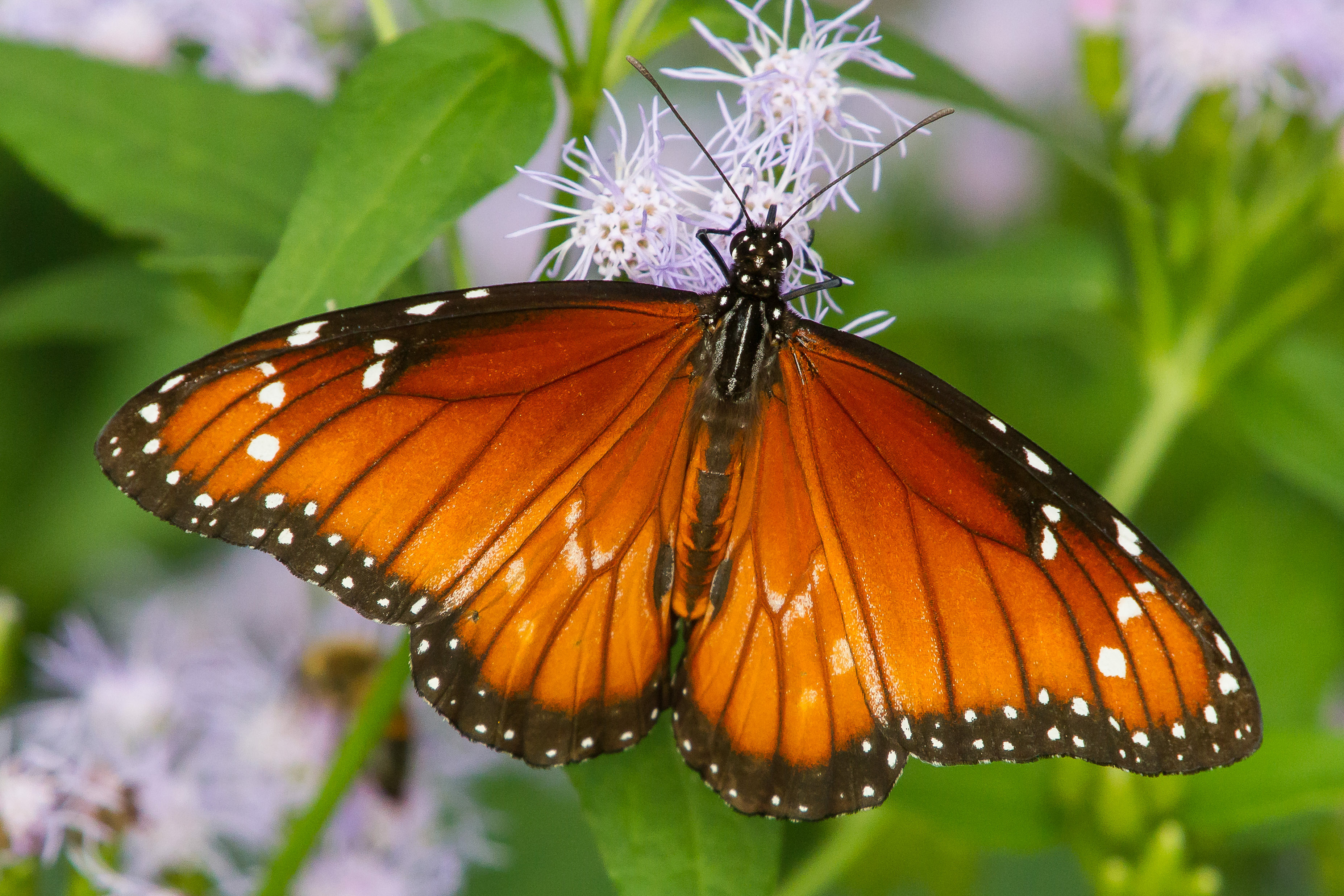
Soldier

Sometimes mistaken for the more common Pearl Milkvine, Plateau Milkvine is a vine to 3 feet that is endemic only to the Edwards Plateau of Central Texas.  This uncommon vine shares the same twining habit of Pearl Milkvine, but its leaves, while similar, generally have a somewhat wavy edge, and its flowers are bell-shaped instead of flat. Additionally, its 0.7 inch wide greenish-white flowers do not have a pearl center, and its petals are not solely reticulate-patterned, having parallel veins in their lower halves and centers, and reticulate or networked veins only on the edges or margins.  Blooming in April and May, this vine can be found on gravelly soils in open woodlands, often climbing on other plants, and is a native host plant for Queen butterflies.  Due to indiscriminate land clearing, this plant is listed as ‘vulnerable’ in terms of its conservation status in Texas.

Plateau Milkvine is a rare cousin to Pearl Milkvine.

The flowers of Plateau Milkvine distinguish it
from Pearl Milkvine.

Queen

Growing up to 8 feet long, Bearded Swallow-wort, also called Thicket Threadvine and Aphid Vine, is a delicate vine that climbs on shrubs and small trees in open woodlands, in thickets, and along roadsides and fencerows in the Edwards Plateau and South Texas. It has small glossy lance-shaped, opposite leaves to 2 inches long, and from March to August, tiny creamy-white flowers appear in loose clusters from the leaf axils.  These flowers are 0.25 inches wide, bell-shaped, and have five distinctively hairy or ‘bearded’ recurved petals.  Five similar species in this genus are present in Texas, but this is the only one with ‘bearded’ flower petals.  Aphids are often found on this plant, giving rise to one of its other common names, and it is the host plant for the Obscure Sphinx Moth (Erinnyis obscura).

Bearded Swallow-wort is a rather delicate climbing vine.

The fringed or 'bearded' flowers
of Bearded Swallow-wort.

Obscure Sphinx

Whether it is due to their scarcity or diminutive stature, it is easy to miss these vines.  While they might be undervalued by humans, they are quite valuable to our native wildlife!


Sunday, April 7, 2019

Royal Ruse

Monarch
As spring unfolds in Central Texas, butterflies begin to appear ever present in our gardens and landscapes.  A subfamily of the Brushfoot butterflies, milkweed butterflies are a group of butterflies whose larva feed only on various milkweed species, and these plants provide the adults with certain chemicals that make them naturally distasteful to most predators.  This subfamily is composed of ‘the royals’, better known as the Monarch (Danaus plexippus), Queen (Danaus gilippus), and Soldier (Danaus eresimus).


Monarch ventral, or underside.
The well-known Monarch is probably the most famous butterfly in North America, but it often confused with the Queen and Soldier.  Monarchs have rich cinnamon-orange wings with distinctive bold black veins and white dots on the black wing borders and on the black body, and look remarkably similar on the underside.  Its larva are striped with yellow, black, and white, and they have two sets of black tentacles rising from their bodies.  

Queens mating, showing their undersides
While the underside of the Queen butterfly can look a lot like a Monarch, it is its upperside that allows for a definitive identification.  Queens can appear almost solid orange compared to stained glass pattern of the Monarch, having rich dark orange wings that lack the black veining and white spots toward the dark wing tips and along their black edges. While adult Queens seek out ageratum, eupatorium, and heliotrope as preferred nectar flowers, adult Monarchs are much broader generalists in terms of their use of many types of nectar plants.

Queen dorsal or upperside, showing white spots along forewing

Soldier dorsal or upperside, showing absence of white spots along forewing
and more obvious wing veining
Soldiers typically occur where Queens are common and are often overlooked due to their very similar appearance.  They can be properly identified by fewer white spots and more obvious dark wing veining on the forewings than on the Queen, but less defined veining than on the Monarch.  Another clue is that Soldiers generally fly in our area in late summer and fall.  Both Soldier and Queen larva are Monarch look-alikes, sporting yellow, black, and white stripes, but with three sets of black tentacles instead of two.

Viceroy dorsal or upperside, showing black band across middle of the hindwing
In an action intended to deceive, the Viceroy (Limenitis archippus) is a milkweed butterfly mimic, using its similar patterning and color to trick predators into thinking it is just as distasteful.  Viceroys are smaller than Monarchs or Queens and usually have a black band across the middle of each hindwing.  This band can be faint or missing, but this butterfly can also be identified by its flying style of quick flaps and flat-winged glides, rather than flying strongly with wings in a shallow V-shape like the Monarch and Queen.  One more way that you can uncover this butterfly’s royal ruse is by knowing that its host plant is willow and not milkweed, and its larva resemble a horned bird-dropping.

Take a closer look the next time you see an orange butterfly on the wing.  It might just be a Monarch heading north, or a Queen or Soldier nectaring on mistflower, or maybe even a Viceroy trying to pull off a royal ruse!

Friday, May 25, 2018

Distinctly Different Milkweeds

Pearl Milkvine
Much ado has been made of the more common and widespread milkweed species, but there are a handful of milkweed vines that are less common but more distinct, and just as useful as native host plants for Monarchs and related butterflies.

A fairly robust, twining vine 6 to 12 feet long growing in dry, light shade in thickets on rocky hillsides and woodland edges, Pearl Milkvine (Matelea reticulata) is best known for its heart-shaped leaves and flat, greenish-white flowers ½ to ¾ of an inch across with pearly, iridescent centers.   Also called Green Milkweed Vine, Net Vine Milkvine, and Netted Milkvine, its curious flowers have tiny white veins forming an intricate pattern on the surface of the petals, adding to their unusual look. In fact, ‘reticulata’ refers to this pattern, which mans ‘resembling a net or network’.  It blooms from April to July, especially in full sun, giving way to fairly large, interesting prickly follicles filled with seeds attached to silky threads.  This native species is a host plant to Monarch butterflies.

Plateau Milkvine

Both the Pearl Milkvine and Plateau Milkvine have prickly seed follicles
Often mistaken for Pearl Milkvine is Plateau Milkvine (Matelea edwardensis), endemic only to the Edwards Plateau of Central Texas.  This uncommon vine shares the same twining habit of Pearl Milkvine, but its leaves, while similar, generally have a somewhat wavy edge, and its flowers are bell-shaped instead of flat.  Additionally, its greenish-white flowers do not have a pearl center, and its petals are not solely reticulate-patterned, having parallel veins in their lower halves and centers, and reticulate or networked veins only on the edges or margins.  Blooming in April and May, this species can be found on gravelly soils in open woodlands, often climbing on other plants, and it is a native host plant for Queen butterflies.

Pearl Milkvine Flowers
Plateau Milkvine Flowers
Purple Milkvine
Usually found in the chalky soils of pastures and open ground, Purple Milkvine (Matelea biflora) has low-growing stems that radiate along the ground from a woody rootstock, and along with its opposite, triangular leaves, are covered with long, spreading hairs.  From March to June, pairs of star-shaped, five-petaled, dark purple-brown flowers rise from the base of the leaves, which gives this plant its other common name of Star Milkvine.  While its trailing stems can grow up to 2 feet long, it inhabits grassy areas and as such is often hidden and overlooked, except by Queen and Soldier butterflies who use it as their native host plant.

Talayote
Named for a small town in Chihuahua, Mexico, Talayote (Cynanchum racemosum) or Milkweed Vine is a climber that grows to 15 to 20 feet in full sun to part shade, and is a native host plant for both Queen and Soldier butterflies.  Talayote produces clusters of small cream and green flowers that are held above and among the heart-shaped leaves, blooming in the hotter months from summer into fall, and attracting a host of other small but beneficial pollinators.  Growing only in Central, South, and West Texas in the United States, this vine produces plump, smooth follicles 3 inches long, filled with silk-topped seeds, often remaining on the vine well into winter. 

Take the time to seek out and appreciate these lesser known members of the Milkweed family, as they are beautifully and distinctly different!