Search Nature Watch

Showing posts with label dragonflies. Show all posts

Monday, September 2, 2024

Migration Isn't Just For The Birds


Wandering Glider dragonflies do more than wander...

Most people who are interested in nature know that each spring many species of birds migrate north, and each fall they migrate south.  But birds aren’t the only animals that participate in this amazing natural phenomenon, as even some insects (other than the well-known Monarch butterfly) participate in long-distance migrations as well.  While insects are the most species-rich and abundant group of macroscopic organisms on the planet, understanding many aspects of their annual cycles and behavior drastically trails behind the ability to identify and classify them. 


Migration is defined as the cyclical travel of an animal as it returns to its place of departure.  It can be accomplished in one or multiple generations.  Some animals don’t migrate at all, and others move only short distances south or north.  While the guiding factors for navigation are still being discovered, migration is typically triggered by local climate, food availability, seasonality, or reproduction.


Adult Common Green Darner

Interestingly, about nine dragonfly species are known to migrate, including the Common Green Darner (Anax junius), Wandering Glider (Pantala flavescens), as well as some species in the Skimmer family such as meadowhawks and saddlebags. These dragonflies are known to travel up to 1500 miles over the full cycle of their migration, taking three generations.


Adult Wandering Glider


The secrets of dragonfly migration were discovered and confirmed by biologists measuring the chemical makeup of their wings.  In their immature or nymph stage, dragonflies grow their wings while still developing in local water.  Because the stable hydrogen isotope concentration varies in concentration by latitude, biologists can estimate the geographic region where adult dragonflies developed as nymphs.  


The female Common Green Darner (bottom) is held by
the male (top) after mating, when ovipositing in water.

From February to August the first generation emerges in the south and migrates north.  From June to October the second generation emerges in the north and migrates south.  Both of these generations have the ability to undergo rapid development from egg to adult.  But from November to March the third generation emerges in the south and is non-migratory, focusing mainly on producing another first generation for the cycle to start again.  It is this generation that employs a different strategy, developing slowly in late fall, entering diapause or actively induced dormancy over the winter, and emerging in early spring.


Dragonfly migration was not well understood until very recently.  Research published in 2018 detailed the journeys of Common Green Darners by analyzing 852 wing samples from eight different countries and utilizing 21 years of citizen scientist observations to link each specimen to its place of origin and establish its migration history. However, it is important to note that the timing of migration and the development of nymphs are both highly temperature dependent, so continued climate change could lead to fundamental changes in the migration cycles for dragonflies and other migrating insect species. So as you can see, migration isn’t just for the birds!


Monday, September 5, 2022

Late Summer Skimmers

The quiet waters of a pond like this make great dragonfly habitat

Dragonflies are conspicuous visitors to various bodies of water, especially in the warmer months of the year.    These visitors include members of the largest family of dragonflies, the Libellulidae, otherwise known as the skimmers. Skimmers can be large and colorful, some with distinctive wing patterns, and are often seen perching on twigs and branches.  In late summer, especially after summer rains, some locally common but not often observed species can be found around newly refilled ponds, including the Gray-waisted Skimmer (Cannaphila insularis), Needham’s Skimmer (Libellula needhami), and Slaty Skimmer (Libellula incesta).  

Found in shady or marshy ponds, typically with tall reeds or cattails, the male Gray-waisted Skimmer has greenish-blue eyes, a white face in front and metallic blue on top, and a dark brown or black thorax divided by several pale stripes.  Its abdomen is pruinose gray on the front half and black on the back half, and its wings are clear with extreme dark only at the tips.  Females and juveniles have a yellow-orange abdomen marked with dark brown or black.  Gray-waisted Skimmers are often found perching in the shade at the tips of vegetation, with their abdomen held nearly parallel to the perch.

Gray-waisted Skimmer, male

The male Needham’s Skimmer has reddish-orange eyes and face, and a thorax than is orange in front and paler or more tannish on the sides. Its abdomen is reddish-orange with a dark dorsal stripe down the length, and its orange wings are somewhat darker along the leading edge.  Females and juveniles have brown eyes and faces, a yellowish-brown thorax, and their abdomens are yellow with a dark stripe running down the middle.  Needham’s Skimmers are typically found perching low on vegetation or overhanging the water’s edge.

Needham's Skimmer, male

Most often seen around marshy forest ponds, the male Slaty Skimmer has dark eyes and a metallic blue or violet face, and both the thorax and abdomen have an overall slaty-blue pruinescence.  The wings are typically clear, but can have a pale bluish stripe along the leading edge.  Females and juveniles have red-over-gray eyes and a pale face, a cream-colored thorax with broad dark shoulder stripes, and a black abdomen with yellowish-orange markings. Females also have more prominent dark wing tips and develop a pale pruinosity at maturity.  Males perch on top of tall grasses and sticks most often in sunlit areas.

Slaty Skimmer, male

Check out your local pond or body of water before the end of September, and you just might be rewarded with a sighting of these less common, late summer skimmers!

Saturday, June 25, 2022

Summertime Skimmers

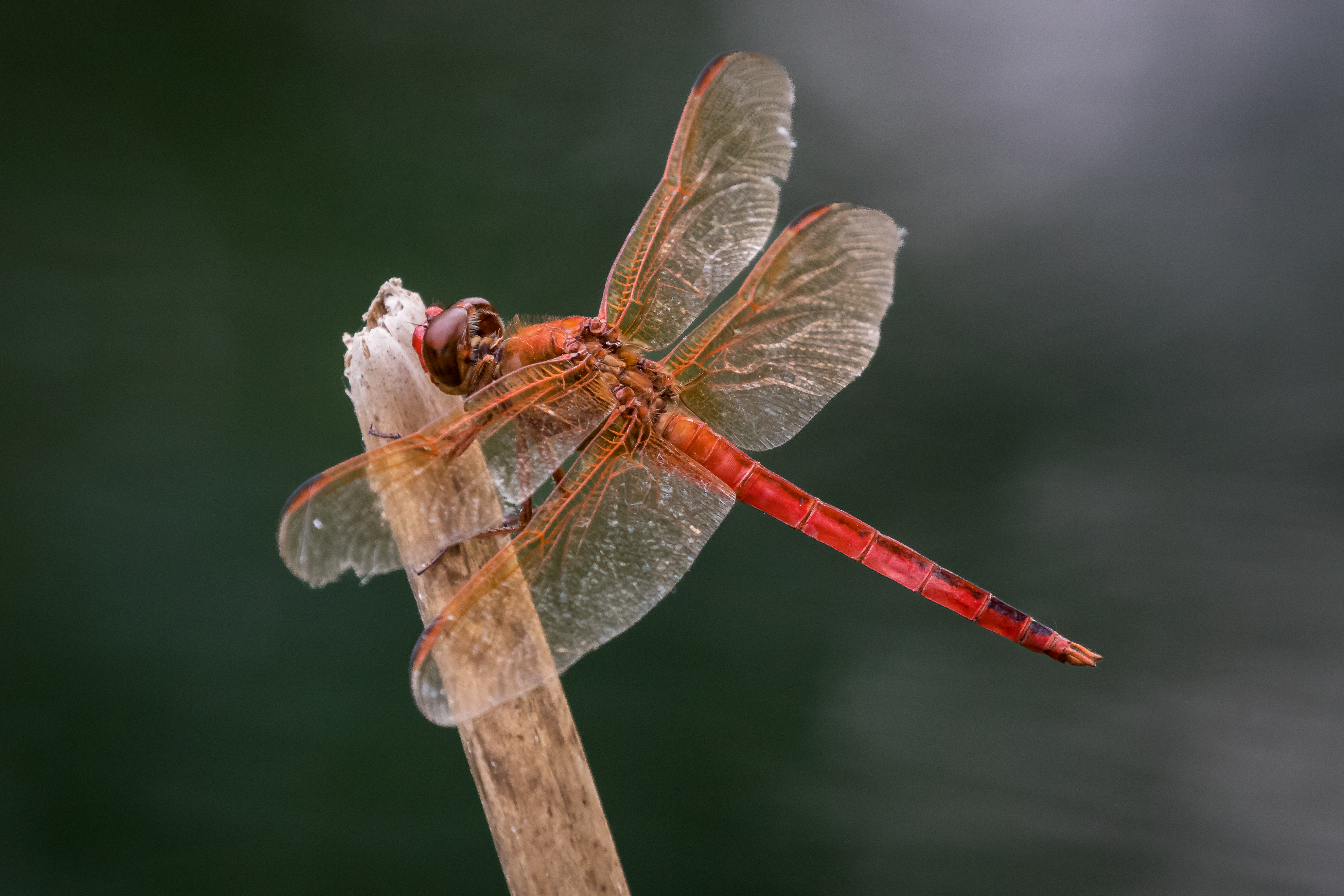
The female Comanche Skimmer looks very different from the male (pictured below).

The heat of the summer is often a good time to search for dragonflies, specifically the skimmers, which comprise the largest family of dragonflies.  They are generally the most obvious, too, as they are frequently seen around ponds lakes, and streams, and perch conspicuously on twigs, bushes, and branches. 

Skimmers are often large and colorful with distinctive wing patterns, and many species of skimmers are sexually dimorphic, meaning the males and females of the same species are different in appearance.  Males frequently develop pruinescence or exhibit a frosty or dusty-looking coating when mature, while most females have little to no pruinescence at maturity.  In our area, some of the less common species include the Gray-waisted Skimmer (Cannaphila insularis), Checkered Setwing (Dythemis fugax), Needham’s Skimmer (Libellula needhami), and Comanche Skimmer (Libellula comanche).

The male Gray-waisted Skimmer has greenish-blue eyes, a face that is white in front and metallic blue on top, and a dark thorax divided by several pale stripes.  The wings are clear except for dark extreme tips, and the abdomen is black on the back half and pruinose gray or white on the front half, which gives rise to its common name.  Females and juveniles have reddish-brown over blue-gray eyes, and the abdomen is yellow or orange with brown or black in between segments.  These skimmers prefer shady, marshy ponds, lakes, and streams, particularly those with cattails or tall reeds, and are on the wing from June to September.

Gray-waisted Skimmer, male

From mid-April to mid-December, you can find Checkered Setwings, as they are widely distributed and sometimes locally abundant.  The male has bright red eyes and face, a reddish-brown thorax with obscured dark stripes, and clear wings except for a large patch of brown coloring near the base.  The abdomen is black with two pairs of pale streaks at the base of each segment, giving it a checkered black-and-white appearance. Females and juveniles are similar, but often have a paler face and a pale thorax with narrow dark stripes.  These setwings favor slow-flowing streams and rivers, ponds, and generally open areas with tall vegetation but little canopy.

Checkered Setwing, female

Male Needham’s Skimmers have reddish-orange eyes and face, thorax orange in front and paler on sides, and wings that have orange veins along the leading edge and clear along the trailing edge, giving them a somewhat bicolored appearance.  The abdomen is reddish-orange with a dark dorsal stripe down its length.  Females and juveniles have brown eyes and a pale face, yellowish thorax, and abdomen yellow throughout with the same dark dorsal stripe as the male.  On the wing from late April to early October, this skimmer prefers marshy ponds and lakes, and is often found perching low on vegetation surrounding or overhanging the water.

Needham's Skimmer, male

Comanche Skimmers can be found on the wing from May to mid-October, around springs, seeps, and sluggish areas of clear-running streams.  The male has aqua-blue eyes, a white face, and both thorax and abdomen with a uniformly blue pruinescence.  The wings are clear but for a bi-colored black and white pterostigma, a group of specialized cells in the leading edge of the wing towards the wing tip.  Females and juveniles have reddish-brown to pale blue eyes and a pale face, a cream-colored thorax with broad dark shoulder stripes, and a mostly yellow abdomen with a broad dark dorsal stripe running down the length.

Comanche Skimmer, male

Brave the heat during these hot months of the year and take a walk around a pond, stroll along a stream, or be on the lookout when on the lake, because you just might see one of these interesting summertime skimmers!


Friday, August 21, 2015

Mysterious Migration

Wandering Glider, Pantala flavescens

Fall migration season is upon us, and that usually conjures up thoughts of songbirds and hawks using the central flyway through Texas to make their way south to the subtropics and tropics for the winter.  However, birds are not the only ones who migrate, and while much has been said about the complex, annual migration made by Monarch butterflies, the record for the longest insect migration (twice the distance of the Monarch) belongs to a dragonfly species, the Wandering Glider (Pantala flavescens).  In fact, dragonfly migration has been suspected for over 100 years, and up to 50 of the world's 5,200 dragonfly species are thought to migrate (about 16 out of 326 in North America), but not much is known about where they are coming from or where they are going.  

Green Darner, Anax junius

In Texas, there are several species of dragonflies that migrate in addition to the Wandering Glider. They include the Common Green Darner (Anax junius), Black Saddlebags (Tramea lacerata), Variegated Meadowhawk (Sympetrum corruptum), and Spot-winged Glider (Pantala hymenaea).   Cooler nights seem to trigger the dragonflies' journey south, and like birds, they build up their fat reserves before setting out.  They may use the lay of the land as a navigation guide, and some scientists speculate that they have an internal magnetic compass, as those that fly off course and out to sea appear to realize their mistake and reorient themselves.  

Black Saddlebags, Tramea lacerata

Dragonflies migrate during daylight hours, and green darners have been found to break their journeys every three days to rest and feed, using oak and juniper trees as stopover sites.  Like monarchs, the full migration circuit takes multiple generations to complete, as it is the offspring of the generation that traveled south in the fall that is migrating north again in the spring.  

Variegated Meadowhawk, Sympetrum corruptum

Swarms of dragonflies can create one of nature's most impressive spectacles, with tens to hundreds of thousands of individuals streaming southward along lakeshores, mountain ridges, and coastlines.  Even with the origins and destinations poorly known, the migration in the fall is more noticeable than that in the spring, presumably because the spring event occurs over a wider front and a longer period of time.  However, migration is the only explanation for how dragonfly adults appear in early spring in places where their nymphs or larvae from the previous year or years have not yet emerged.

Spot-winged Glider, Pantala hymenaea

The ecological role of migrating dragonflies is another facet of the mystery yet to be resolved. Since several species use the same migration strategies and timing as migratory birds, traveling at the same times and concentrating in the same places, it is likely that certain bird species are exploiting the abundance of dragonflies as a source of fuel for their own migration.  More research is being done to solve these mysteries, most notably the Xerces Society’s Migratory Dragonfly Partnership initiative, which uses “research, citizen science, education, and outreach to understand North American dragonfly migration and promote conservation.”