Search Nature Watch

Showing posts with label passionvine. Show all posts

Friday, August 7, 2026

Brooding Butterflies


Common Sunflower is a native larval host plant for one of our brooding butterflies. 

In human terms, brooding typically means showing deep, quiet unhappiness but when it pertains to butterflies, it describes how many broods or distinct generations of butterflies a species produces in one year. Summertime in our area highlights those butterfly species that have multiple broods spring through fall, also called multivoltines. The most commonly seen multiple brooders include Queen (Danaus gilippus), Gulf Fritillary (Dione vanillae), Bordered Patch (Chlosyne lacinia), White-striped Longtail (Chioides albofasciatus), and Pipevine Swallowtail (Battus philenor) butterflies.

Queens are most often confused with Monarchs, given their mostly rich orange-brown coloring, with white spots nearest the wing tips and in the black wing margins, but lacking the Monarch’s bold black wing veining. Like Monarchs, their native larval host plant is milkweed, specifically Antelope Horn, Fringed Twinevine, and Butterfly Milkweed.

Queens are often mistaken for Monarchs.

Gulf Fritillaries are another mostly orange butterfly, with a few black markings on the wings above and many elongated silvery spots on the wings below.  They have slightly elongated wings and their flight is fast and usually well above the ground. Their native larval host plant is passionvine, including Purple Passionvine, Fetid Passionvine, and Yellow Passionvine.

Gulf Fritillary nectaring on Blue Mistflower.

Silvery spots on the underside of the Gulf Fritillary.

Bordered Patches can be remarkably variable, but typically have black forewings and hindwings with an orange and/or creamy white median band of spots that can vary in width. Their native larval host plants are in the sunflower/aster family, specifically Common Sunflower, Cowpen Daisy, and Black-eyed Susan.

Bordered Patch on one of its native larval host plants, Cowpen Daisy.

White-striped Longtails are brown butterflies with very long tails and a prominent white stripe on the hindwing below. This characteristic is usually easy to see since these butterflies typically perch with their wings closed. Their native larval host plants are legumes in the pea family, namely Panicledleaf Ticktrefoil and Softleaf Mimosa.

White-striped Longtail nectaring on Blue Mistflower.

Pipevine Swallowtails are our most familiar dark swallowtail, black above with a single row of pale spots near the wing margins. Males have a beautiful blue-green iridescence on the hindwing above, and both sexes have a single row of bright orange spots in an iridescent blue background on the hindwing below. Their native larval hosts plants are pipevines, including Swanflower and Virginia’s Dutchmanspipe.

Upperside of a male Pipevine Swallowtail.

Underside of a Pipevine Swallowtail.

These multiple brooders produce three or more continuous generations per year, often flying repeatedly from early spring to late fall. The final brood of the year often exhibits different physiological or behavioral traits, such as delayed development or seasonal movement, that allows them to survive winter conditions. In the case of the species outlined above, most move further south as the temperatures fall and then north again as they rise, but the swallowtails overwinter hidden away in chrysalis form until warmer temperatures coax them to emerge in spring.


Friday, June 16, 2023

Unfamiliar Passionvines


Birdwing Passionvine

While many flower and butterfly gardeners are familiar with the more common Passiflora species, namely Purple (P. incarnata), Yellow (P. lutea), and Stinking Passionvines (P. foetida), they are not the only species in this genus native to Texas.  Some of the unfamiliar native species include Bracted Passionvine (P. affinis), Corkystem Passionvine (previously P. suberosa now P. pallida), and Birdwing or Slender-lobe Passionvine (P. tenuiloba). 

The Bracted Passionflower is a climbing vine to 15 feet in length, with alternate, three-lobed leaves that is found growing in riparian to dry limestone areas of the Edwards Plateau.  The leaves are often appropriately shaped somewhat like cowboy hats. While similar to Yellow Passionvine, it is distinguished by having tiny nectaries on the underside of the leaves and small bracts or leaflike structures at the base of each flower. Each of these intricate flowers are pale yellowish-green to white and about 1 inch across with yellow fringelike segments purple at the base, and they can appear from May through October.  They produce small round berries 0.4 inches across that are green at first, but turn purple-black as they ripen.

Bracted Passionvine

Tiny dots on the surface of Bracted Passionflower 
leaves indicate the nectaries below, 
differentiating it from Yellow Passionvine

With stems up to 20 feet long, Corkystem Passionvine is naturally found in a few counties in South Texas, preferring subtropical woodlands and shrublands with rocky, sandy, and often calcareous soil.  Its common name comes from the corky bark it develops at the base of older stems. Alternate, three-lobed leaves are 1 to 4 inches long, somewhat glossy, and dark green.  Its 1-inch, complex blooms can be white, yellow, or green with a tinge of reddish-purple at the base of the yellow fringelike segments.  Blooming can occur any month of the year, eventually yielding bluish-black, slightly egg-shaped berries up to about 0.25 inches in diameter.

Corkystem Passionvine

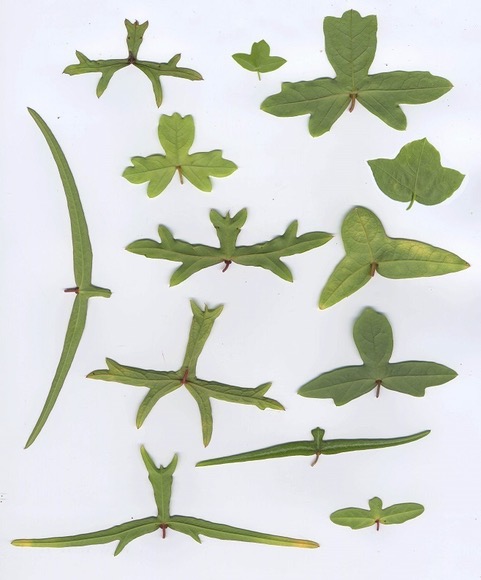
The hardest-to-find small Passiflora vine is the Birdwing or Slender-lobe Passionflower (Passiflora tenuiloba). Growing on open limestone areas with dry, caliche soils, often over boulders or tree stumps mainly in the Edwards Plateau to South and West Texas, this vine can display quite a wide variety of leaf forms (compare the leaf shape the photo below with the one in the banner at the top of the post, for example).  While roughly symmetric, the alternate leaves are typically as wide as to usually wider than long, 3 to 9 lobed, and resemble the outline of a bird with spread wings. Its small, intricate blooms are 0.75 inches across, greenish-yellow with yellow fringelike segments that can be purple at the base.  Flowers can appear from April to December, turning into 0.35 inch wide dark blue to black berries.

Birdwing Passionvine

Birdwing Passionvine Leaf Variation 
©Doug Goldman, 2001, Cornell University

Most Passiflora species are host plants for longwing and fritillary (Heliconian) butterflies, such as the more common Gulf Fritillary and Variegated Fritillary, as well as the less common Zebra Heliconian and Julia Heliconian.  The larvae of these species feed on passionvines, and chemicals from these plants make the adults noxious to predators. 

The naming of the Passiflora genus of plants comes from the description of their intricate flower parts in the early 17thcentury by Spanish priests.  Known by the Spanish as La Flor de las Cincos Llagas or ‘The Flower with Five Wounds’, the passion flower refers to Christ’s suffering and its parts represent various elements of the crucifixion. The five petals and five sepals are the ten disciples less Judas and Peter, the corona filaments are the crown of thorns, the five stamens with anthers are the five sacred wounds, and the three stigmas are the nails by which Christ was bound to the cross.  While this symbolism is not universal, it is still an important reminder today in Christian societies throughout the world.