Search Nature Watch

Showing posts with label landscaping. Show all posts

Wednesday, August 3, 2022

Beat the Heat


Flame Acanthus is a hot weather bloomer.

The heat of the Texas summer is enough to make everything wilt, but there are some native plant species that truly thrive in these unrelenting temperatures and drought-stricken conditions.  These plants include Turk’s Cap (Malvaviscus arboreus var. drummondii), Flame Acanthus (Anisacanthus quadrifidus var. wrightii), Violet Ruellia (Ruellia nudiflora), and Western Ironweed (Vernonia baldwinii).

Turk’s Cap, also known as Drummond’s Turk’s Cap, Wax Mallow, Mexican Apple, Manzanita, and Sleeping Hibiscus, is a spreading shrub to 4 feet high, with large green leaves on upright stems.  Bright red flowers atop the stems are twisted into a whorl from which protrude red stamens.  These flowers are a natural source of nectar for hummingbirds and butterflies, and it is a host plant for the Turk’s-cap White-Skipper butterfly.  The resulting fruit is red and marble-sized, and edible for animals and humans alike. Turk’s Cap is the perfect plant to grow under trees that tend to shade out non-native turf grasses, as they form a natural cover and provide much needed color from May all the way to November.


Turk's Cap

Turk's Cap fruit

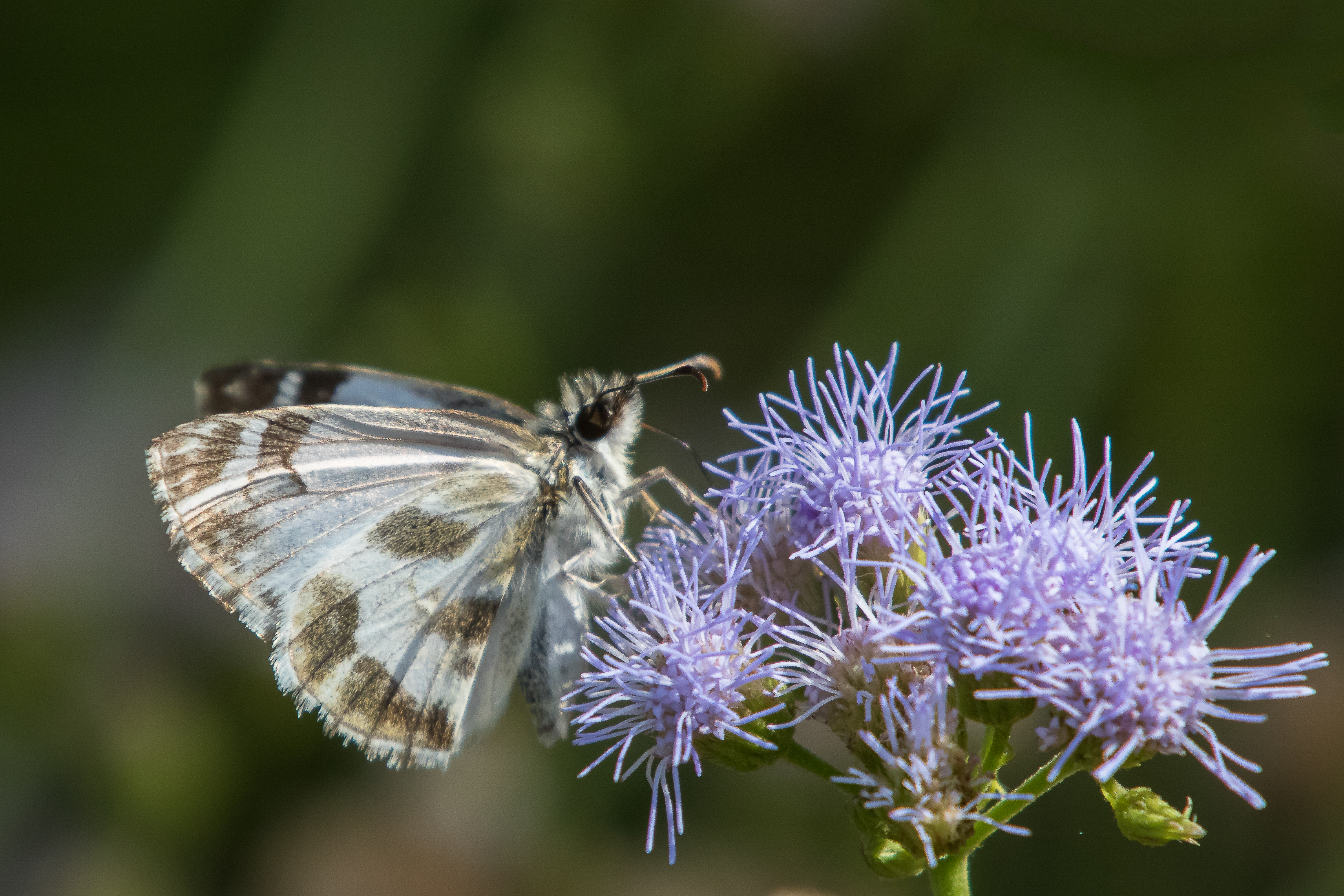
Turk's-cap White-Skipper

An airy, spreading shrub to 5 feet tall, Flame Acanthus has tender lance-shaped green leaves and tubular red flowers that open to 4 lobes and occur along terminal spikes.  Blooming in full sun from June to October, it attracts both hummingbirds and butterflies, and is also known as Hummingbird Bush, Wright’s Acanthus, and Mexican Flame.  It is the host plant for the Crimson Patch, Elada Checkerspot, and Texan Crescent butterflies. The fruit is a small, hood-shaped capsule with seeds attached to a hooked stalk that helps to eject them from the capsule when it dries and splits open.

Flame Acanthus

Flame Acanthus seed capsule

Crimson Patch

Violet Ruellia is an erect herb that is woody at the base with few branches, growing to 2 feet tall.  The dark green leaves are oval-shaped, and the trumpet-shaped violet flowers at the ends of stalks open at sunrise and fall from the plant in early afternoon, from March all the way through October. Also called Wild Petunia, it does well in sunny areas and is a host plant for the Common Buckeye butterfly.  One of its’ subspecies is a host plant for the Malachite butterfly, a south Texas species rarely seen in central Texas.

Violet Ruellia

Common Buckeye

Often stout and forming colonies 5 feet high, Western Ironweed has hairy unbranched stems, large green leaves with serrated edges, and loose clusters of bright purple blooms at the apex of each stem.  From July to the first frost, these fuzzy blooms provide nectar for various types of pollinating insects and the seeds nourish several species of birds.  Also called Baldwin’s Ironweed, it is the host plant for the Parthenice Tiger Moth.  While this species’ growth can be aggressive, it flourishes if allowed to spread in larger, open, sunny areas.

Western Ironweed

These native species can (and often should) be pruned back in winter as they can get too leggy.  They have low water needs once established, and can tolerate hot temperatures and still continue to bloom.  They are the perfect plants to beat the heat, benefit our local wildlife, and provide much needed color in your own native summer garden!


Wednesday, July 28, 2021

Outmaneuvering Mosquitos

Mosquitos can be a nuisance in the hot summer months.

As the temperatures start to increase so do the ads for mosquito-control companies that offer to blanket spray residential landscapes.  While many of these businesses claim that their treatments only kill mosquitos and other pests, in reality the broad-spectrum insecticides they use kill many other species.

Broad-spectrum insecticides are indiscriminate, and along with killing mosquitos, they also kill pollinators and other beneficial insects such as bees, butterflies, moths, caterpillars, dragonflies, damselflies, and lady beetles.  The damage continues further up the food chain, when birds die as their insect food disappears and aquatic animals such as fish die when these chemicals wash off our landscapes and flow into nearby creeks, ponds, rivers, and lakes. Even spraying with essential oils such as peppermint, rosemary, and lemongrass is discouraged, as these can also kill beneficial insects.

Keeping mosquitos at bay can be vital, with many mosquito-borne tropical diseases such as West Nile, Zika, and Dengue fever spreading in range.  However, there are other natural, safer alternatives to using broad-spectrum insecticides.  It starts with understanding that mosquitoes can breed in less than one inch of water, and that the most effective way to reduce their numbers is to target the larvae, not spray adults.  

Moving water discourages female mosquitoes from laying eggs.

Begin by removing any standing water in gutters, bird baths, flower pot saucers, children’s pools, pet bowls, watering cans, and anything else that can hold water. Female mosquitoes avoid laying eggs in moving water, so consider adding a small pump or fountain to a water feature. For standing water that cannot be drained, use a mosquito dunk that contains the natural bacterium Bti (Bacillus thuringiensis israelensis) that kills mosquito larvae as they hatch, and consider adding native mosquitofish (Gambusia species) if the water feature is permanent.  Mosquitos are weak flyers, so even setting up fans reduces their ability to find an individual.

Black-chinned Hummingbirds get protein from eating insects like mosquitoes.
.
Neon Skimmer dragonflies love to prey on mosquitoes.

Most surprising to many, those who garden for wildlife using native plants have fewer mosquito problems than those with non-native turf lawns.  Native plants attract natural mosquito predators such as birds (warblers, wrens, woodpeckers, hummingbirds), dragonflies, damselflies, frogs, turtles, and bats.  Hummingbirds consume hundreds of insects daily in addition to drinking nectar, dragonflies and turtles eat mosquito larvae before they can hatch, frogs specialized sticky tongues nab all kinds of insects, and bats consume millions of insects on the wing.

The sticky tongues of frogs like this Leopard Frog can catch adult mosquitoes.
Red-eared Slider turtles eat mosquito larvae before they hatch.

It is important to note that even if you have a native landscape and don’t spray for mosquitos but your neighbors do, you will still lose pollinators and other beneficial insects.  Recent studies have shown that nearly 3 billion birds have disappeared from North America since 1970 due to loss of their insect prey, and many insect species are rapidly declining or vanishing altogether. 

Make your voice heard by spreading the message that insecticides are significant contributor to wildlife decline, and how we outmaneuver mosquitos in our landscapes truly matters to us all.



Monday, March 11, 2019

Plant Natives!

Non-native, invasive, Nandina - Please avoid planting this and consider removing it from
your landscape.  It is a pest in our parks and preserves.
Spring is the ideal time to think about planting, and how you manage your garden or landscape can have an effect on the overall health of the soil, air, water and habitat for native wildlife as well as our human community. Help conserve and improve the quality of these resources by using sustainable gardening practices such as mulching and composting, reducing or eliminating lawn areas, xeriscaping (planting native, drought-tolerant plants), installing rain barrels, and removing non-native invasive plants and restoring native ones.

The U.S. government defines an invasive plant species as one “that is not native to the ecosystem under consideration and whose introduction is likely to cause economic or environmental harm or harm to human health.” These species grow outside desired boundaries, out-competing native species, and spread by seeds, berries, spores, runners, rhizomes, and stems. Some can be easily transported long distances, and every year millions of our tax dollars and thousands of volunteer hours are spent trying to eradicate them.

Many of these plants have already invaded our preserves and greenbelts in Austin, originating in our landscapes, escaping cultivation and spreading into the wild. Invasive species may grow faster, taller, or wider and shade out native species. Many stay green later into the season or leaf out earlier, giving them an advantage over natives. They can change the vertical and horizontal structure of ecosystems, alter hydrology, and disrupt nutrient cycles, all of which can have devastating effects on native plants and animals.

Although invasive exotics may offer birds fruit, squirrels nuts, and hummingbirds and butterflies nectar, they do not provide the entire range of seasonal habitat benefits that an appropriate locally native species will provide. If we want not only to satisfy our desires to attract wildlife, but also to restore the critical, often unseen, small pieces in our ecosystems, we need to bring back our locally native plants. These plants are not only attractive to humans, they also meet the food and cover needs of all wildlife species: bees, wasps, butterflies, grasshoppers, bugs, beetles, spiders, and thousands of others that sustain and support food webs which songbirds, salamanders, bats, toads, and box turtles more visibly demonstrate.

Escarpment Black Cherry is a beautiful native tree that makes a great replacement for the

highly invasive privets or ligustrums.
Aside from attracting a diversity of wildlife, the use of native plants minimizes the impact our landscapes have on the natural environment around us. They reduce water consumption, eliminate the need for chemical fertilizers and pesticides, and limit the competition from invasive exotics. This results in a much healthier habitat—water, soil, and air—for humans and animals alike, and is less costly, too. Invite wildlife to put on a show in your backyard by replacing the invasives in your landscape, and encourage your neighbors to do the same.


Non-Native/Invasive Plant(s)
Some Native & Adapted Alternative(s)
Bamboo 
Wax Myrtle (Morella cerifera)
Yaupon Holly (Ilex vomitoria)
Bamboo Muhly (Muhlenbergia dumosa)
Chinaberry
Chinquapin Oak (Quercus muehlenbergii)
Texas Red Oak (Quercus buckleyi)
Chinese Tallow Tree 
Bigtooth Maple (Acer grandidentatum)
Lacey Oak (Quercus laceyi)
Elephant Ear
Arrowhead (Sagittaria latifolia )
Crinum Lily (Crinum americanum)
Pigeonberry (Rivina humilis)
Frogfuit (Phyla nodiflora)
Horseherb (Calyptocarpus vialis)
Giant Cane
Roughleaf Dogwood (Cornus drummondii)
Yaupon Holly (Ilex vomitoria)
Japanese Honeysuckle
Coral Honeysuckle (Lonicera sempervirens)
Passion Vine (Passiflora foetida or incarnate or lutea or tenuiloba)
Rock Rose (Pavonia lasiopetala)
Holly Fern
River Fern (Thelypteris kunthii)
Kudzu, English Ivy, Vinca
Virginia Creeper (Parthenocissus quinquefolia)
Trumpet Vine (Campsis radicans)
Coral Vine (Antigonon leptopus)
Ligustrum (all species) or Common Privet
Evergreen Sumac (Rhus virens)
Barbados Cherry (Malpighia glabra)
Yaupon Holly (Ilex vomitoria)
Possumhaw Holly (Ilex decidua)
Texas Sage (Leucophyllum frutescens)
Cherry Laurel (Prunus caroliniana)
Black Cherry (Prunus serotina)
Mimosa
Desert Willow (Chilopsis linearis)
Texas Redbud (Cercis canadensis var. texensis  )
Elbowbush (Forestiera pubescens )
Nandina or Heavenly Bamboo
Texas Lantana (Lantana urticoides)
Bush Germander (Teucrium fruticans)
Texas Sage (Leucophyllum frutescens)
Paper or White Mulberry
Red Mulberry (Morus rubra)
Texas Persimmon (Diospyros texana)
Possumhaw Holly (Ilex decidua)
Cherry Laurel (Prunus caroliniana)
Pyracantha 
Yaupon Holly (Ilex vomitoria)
Possumhaw Holly (Ilex decidua)
Evergreen Sumac (Rhus virens)
Red-tipped or Chinese Photinia
Evergreen Sumac (Rhus virens)
Carolina Buckthorn (Frangula caroliniana)
Yaupon Holly (Ilex vomitoria)
Russian Olive
Texas Persimmon (Diospyros texana)
St. Augustine Grass
Buffalo Grass (Bouteloua dactyloides)
Tamarisk or Salt Cedar
Bald Cypress (Taxodium distichum)
Arizona Cypress (Cupressus arizonica)
Tree of Heaven
Chinquapin Oak (Quercus muehlenbergii)
Lacey Oak (Quercus laceyi)
Vitex or Chastetree
Texas Pistachio (Pistacia mexicana)
Mexican Buckeye (Ungnadia speciosa)
Wisteria
Passion Vine (Passiflora foetida or incarnata or lutea or tenuiloba)
Trumpet Vine (Campsis radicans)

Wednesday, February 22, 2017

Three Terrific Trees


Mexican Plum in full bloom
Trees are often planted for their ornamental value, or to provide shade, but there are many other reasons to plant them.  They improve air quality by producing oxygen and storing carbon, which offsets the harmful byproducts of burning fossil fuels.  They can moderate the effects of sun and wind, reduce air conditioning costs, and clean the air by trapping dust and pollen.  Trees can also be credited with increasing property values, lowering our heart rates and reducing stress, and providing shelter and food for many types of wildlife.

In Central Texas, three terrific trees that are native to our area include Escarpment Black Cherry (Prunus serotina var. eximia), Mexican Plum (Prunus mexicana), and Carolina Buckthorn (Frangula or Rhamnus caroliniana).  All three of these trees are medium-sized, deciduous, display fall color, and benefit wildlife by producing fruit.

Escarpment Black Cherry blooms
Escarpment Black Cherry is a distinct variety of Black Cherry, found only on the calcareous soils in our wooded hill country canyons, slopes, and floodplains.  Up to 50 feet tall, this tree is prized for its attractive silvery trunk and branches, five-inch long clusters of showy white blooms that occur in March and April, juicy summer fruits, and vivid yellow to red fall foliage.  While the small dark red to purple-black cherries it produces are edible, the rest of the plant is not, and the cherries are often eaten first by birds.  Several butterflies, including Viceroy, Eastern Tiger Swallowtail, Two-tailed Swallowtail, Red-spotted Purple, and Striped Hairstreak use this tree as their host plant. 

Escarpment Black Cherry fruit
Often called the ‘star of our native plums’, Mexican Plum is easily recognizable in spring, as it is an early bloomer.  Before the leaves appear, white to pale pink, five-petaled flowers cover the 15 to 35 foot tall tree from February to April, and they are extremely fragrant, attracting several species of native bees and butterflies.  Plums up to one-inch wide turn from yellow to mauve to purple as they ripen July through September, and they are edible for humans and wildlife alike.  Thick, five-inch long leaves provide food for the Eastern Tiger Swallowtail and Cecropia Silkmoth, and turn a showy shade of orange in autumn. Mature trunks are a beautiful satiny blue-gray with horizontal striations, typical of most fruit trees.

Mexican Plum fruit
A flowering Carolina Buckthorn
Lesser known is the Carolina Buckthorn, an understory tree 12 to 15 feet tall, with oval, shiny green leaves and small yellow clusters of blooms produced near the leaf stems in May and June. It prefers bottomlands, canyons, and streamsides, and in light shade it is airy and tiered.  Bright red fruits turn to black when ripe, and are relished by many birds and mammals.  The leaves stay green into late fall, turning various colors from yellow-gold to bronze-sienna as the weather cools. Carolina Buckthorn is also the host plant for Spring Azure, Gray Hairstreak, and Painted Lady butterflies.

Carolina Buckthorn berries
Consider adding one or all of these terrific trees to your property.  While the best time to plant trees in Central Texas is in the fall, it’s never too late to plan for future enhancements to your native landscape!