Search Nature Watch

Showing posts with label life. Show all posts

Saturday, June 19, 2021

Bodacious Borers


Cottonwood Borer

As spring turns into summer in Central Texas, the heat brings out some of our most interesting creatures, most notably the native wood-boring beetles.  This group encompasses many species and families of beetles, all of whom eat wood either in their larval or adult form.  Most often they are found in or around dead or dying trees, as they are vital players in enabling the turnover of weak trees with strong ones, and acting as primary decomposers of wood which allows for the recycling of nutrients back into the soil.

One large family of beetles in the wood-boring group is the longhorn beetles, or Cerambycidae, typically characterized by their extremely long antennae which are often as long or longer than the beetle’s body.  Their family scientific name comes from the mythological Greek shepherd Cerambus, who was turned into a large beetle with horns after an argument with nymphs.  Three of the more noticeable wood-boring longhorn beetles in our area include the Banded Hickory Borer (Knulliana cincta), Cottonwood Borer (Plectrodera scalator), and Texas Bumelia Borer (Plinthocoelium suaveolens plicatum).

Banded Hickory Borer

With a body length of up to 1.4 inches, the Banded Hickory Borer is a fairly slender, typically gray to reddish-brown beetle with a pair of pale marks near the base of the elytra or wing covers that are sometimes absent, and tiny spines at the ends of the elytra.  Eggs are laid by the adults in bark crevices or directly into hardwoods such as oak, pecan, walnut, willow, and hackberry, upon which their larva feed.  In their first season, the larva feed just beneath the bark, then head deeper into the wood as they develop, a cycle which takes two to three years to complete.

Cottonwood Borer

The Cottonwood Borer is an elongate, unmistakably robust beetle with black and white markings that are formed by contrasting areas of white pubescence or fine short hairs on black body parts.  At a body length of up to 1.6 inches, the summer-active adults lay eggs in August and September on cottonwood and willow, where larva bore into the base and overwinter.  After two or three years to reach maturity, they pupate in chambers beneath the bark and emerge as adults in late spring, and are often found feeding on new shoots, leaf petioles (stems), and the bark of their host trees.

Texas Bumelia Borer

One can hardly miss the bright iridescence of the metallic green Texas Bumelia Borer, with its contrasting reddish-orange and black legs. The larva of this species feed on gum bumelia and mulberry, developing in the roots and trunks of these host plants.  With a body length of 1.5 inches, the adults are diurnal and often found on the trunks of their host plants, although they typically feed on flower nectar and are attracted to lights.

Despite their large size, most native wood-boring beetles are not pests.  Instead, they take advantage of dead and dying trees and aid in the natural decomposition process. As you venture out and about this summer, see if you can find some of these bodacious borers!


Tuesday, May 1, 2018

A Horse of a Different Color

Horsetail or Scouring Rush

Few plant species that grow naturally today have been around for over 100 million years, but one of the best known are plants in the genus Equisetum, which is the only living genus of the entire family of Equisetopsida, most commonly known as horsetails.  They are recognized as close relatives of ferns, typically growing in wetter areas with whorls of needle-like branches radiating at regular intervals from each single vertical stem.

The common name of horsetail is used for the entire group of plants, since the branched species resemble a horse’s tail.  In fact, the genus Equisetum comes from the Latin equus or ‘horse’ and seta or ‘bristle.’  Another common name is scouring rush, referring to the upright rush-like appearance of the plants, and the fact that the longitudinal ridges of the stems are coated with abrasive silicates, making them useful for scouring or cleaning metal items.  It is still used today as a traditional polishing material in Japan.

The primary species of horsetail that occurs natively in wet or moist areas of Texas, most commonly on the Edwards Plateau and in Blackland Prairie, as well as most of the non-tropical northern hemisphere, is Equisetum hyemale.  A spreading, reed-like perennial growing to 3 feet tall, each stem is evergreen, cylindrical, jointed, hollow, and about 1/4 of an inch in diameter.  In this species, the needle-like branches appear non-existent, but are actually small and fused around the stem at each joint or node, forming a blackish-green band or sheath.  Interestingly, the pattern of spacing of the nodes in these plants, which grow increasingly close together toward the apex, is precisely what inspired Scottish mathematician John Napier to discover logarithms in the late 16th century.

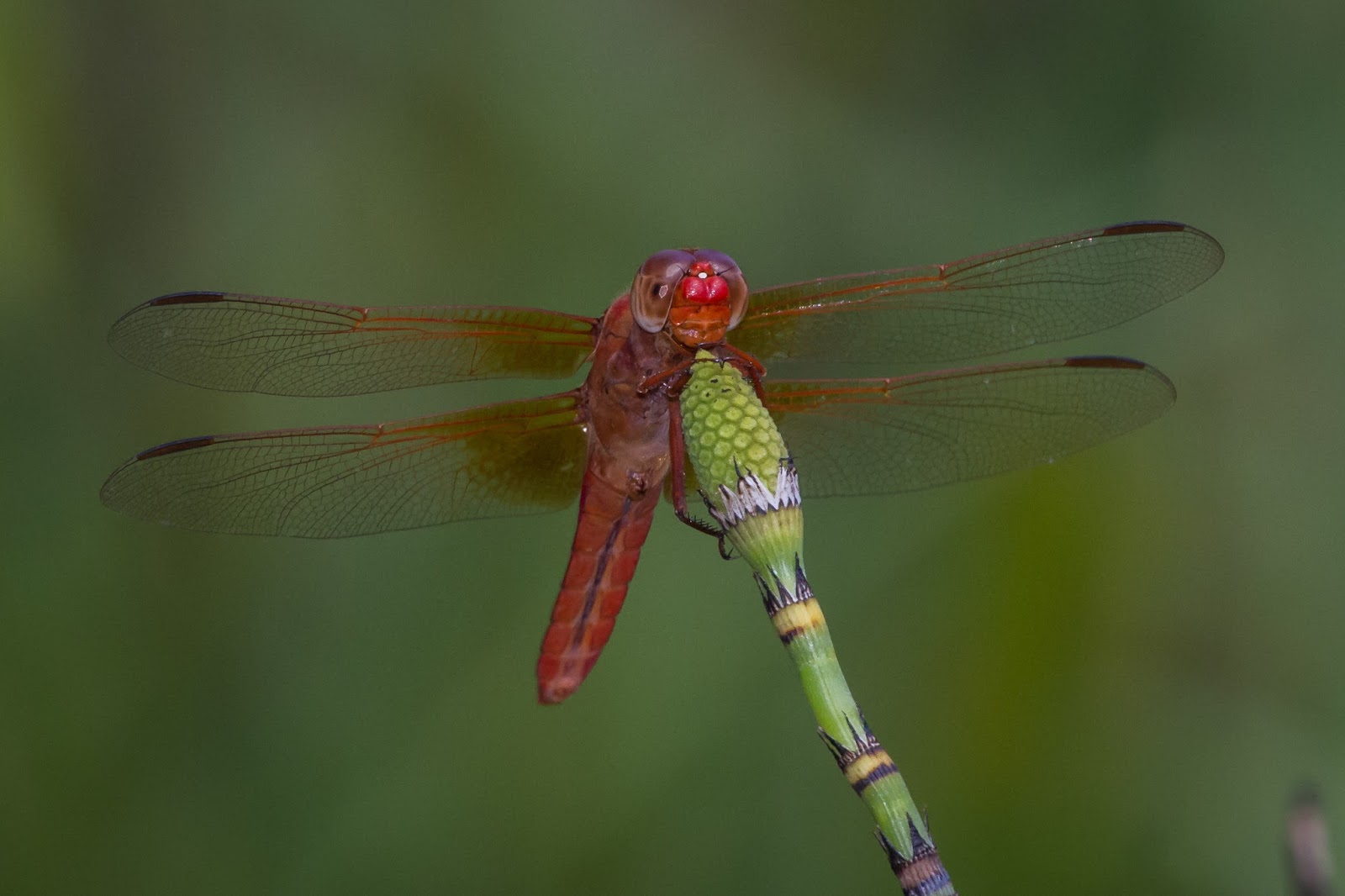
Dragonflies, like this Neon Skimmer, love to perch on the cones of
the horsetail’s upright stems.

Horsetail prefers open or wooded areas along streams, moist flats, and wet ledges. Like ferns and other related species, horsetails reproduce by spores rather than through seed-producing flowers. These spores are borne in cone-like structures at the tips of some stems, and are mostly homosporus, meaning of the same size and type.  The tiny spores have four elaters or structures that alter shape in response to changes in moisture, effectively acting as moisture-sensitive springs that assist spore dispersal through crawling and hopping motions once released from the cone.

Horsetails reproduce by spores borne in the cone-
like structures at the tips of some stems.

The upright, evergreen, segmented foliage of horsetail is an appropriate plant for a rain garden, pond edge, water feature, or area with moist soil, and is an excellent perching plant for dragonflies. While it can spread quickly by underground or underwater runners, it is easily kept in check by periodic pulling or by planting it in a container.  Few plants add as much interest or vertical structure to a wildscape as this living fossil, which is clearly a  ‘horse of a different color’!


Monday, January 23, 2017

Winter Chorus


Clear and bell-like, consisting of a single, quickly repeated note, the call of the male Strecker’s Chorus Frog (Pseudacris streckeri) is unmistakable.  In the midst of winter, especially in the peak calling season from January to early March, multiple males call at the same time, their alternating notes resulting in an unexpectedly delightful winter chorus rising up from the canyons!

Reaching an adult length of 1 to 1.5 inches, this largest chorus frog is identified by a stout gray, brown, olive, or green body, a dark brown mask-like stripe through the eye and a dark spot under the eye, dark longitudinal stripes along the back, and a deep golden or orange color in the groin. Males are slightly smaller than females and have greenish-yellow vocal sacs.  The genus Pseudacris comes from the Greek pseudes meaning ‘false’ and akris meaning ‘locust’, and is likely a reference to the repeated rasping calls of most chorus frogs, which are similar to and can be mistaken for those of an insect.


Although Strecker’s Chorus Frog is mainly a nocturnal frog, its call can be heard day or night. Males call as they hang on to or sit on vegetation, or from the bank above the water’s surface. Typically feeding on insects, this chorus frog is seen most often in moist woodlands, rocky ravines, near streams or in swamps.  While its range includes portions of Kansas, Illinois, Missouri, Oklahoma, Arkansas, and Louisiana, the individuals in Texas are of the subspecies P.s. streckeri, and occur in most counties in the eastern half of our state.


Aside from its distinctive winter chorus, Strecker’s Chorus Frog is also distinguished by its ability to use its forelimbs to burrow headfirst, unlike other amphibians that typically use their hind legs to back into a burrow.  It burrows deeply in sand or mud and hides under rocks and woody debris to protect itself from heat and predators, emerging mainly after heavy rains. Following these rains, it migrates a short distance to a preferred breeding site.

Strecker’s Chorus Frog is a cold-tolerant, winter breeding frog, breeding anytime between November and March when rains are adequate. While most frogs prefer to breed in flowing water, Strecker’s Chorus Frog prefers still, clear, temporary water bodies such as ditches, ponds, and pools in wet weather creeks.  Females attach their small, jelly-covered clusters of eggs to vegetation below the water’s surface, and the time to hatch, while water temperature dependent, is usually just a few days.  Tadpoles take around two months to transform into adult chorus frogs.  In spring, at a time when most other frogs are just beginning to seek their breeding ponds, Strecker’s Chorus Frogs terminate their breeding activities.

Named after John Kern Strecker, Jr (1875 – 1933), a Texas naturalist and Curator of the Baylor University Museum (renamed the Strecker Museum in 1940 in his honor), this chorus frog with its peculiar and unusual habits and haunting winter chorus might have been a perfect candidate for “Strecker’s Cabinets of Curiosities”!  

If you’d like to see and hear the chorus for yourself, check out the video at https://texaswild.me/2014/03/31/streckers-chorus-frogs-calling/


Thursday, February 11, 2016

Fabulous Foxes


Gray Fox, Urocyon cinereoargenteus

Members of the Canidae family are all dog-like mammals, and in the United States that includes wolves, coyotes, domestic dogs, and true foxes.  They are adapted to running swiftly over open terrain, and typically have long muzzles, upright ears, bushy tails, and teeth that can crack bones. The family is further divided into two tribes, with the wolves, coyotes, and dogs in the Canini tribe, and the true foxes in the Vulpini tribe.  In central Texas, two species of true foxes exist, the native Common Gray Fox (Urocyon cinereoargenteus) and the introduced Red Fox (Vulpes vulpes).  


Gray Fox, Urocyon cinereoargenteus
Most active at night, and sometimes in late afternoon or early morning, the Gray Fox is a medium-sized fox with grayish upperparts, tawny sides, and reddish-brown legs.  It has a whitish throat with a distinct black patch on the sides of its muzzle and lower jaw.  Often confused with the Red Fox, the main distinction is the black tip on the tail and the fact that it is found throughout Texas.  Gray Foxes are adept tree climbers, highly unusual for Canids, and they use their rounded claws to ascend trees much like bears.  Once up in the canopy, they can hunt birds, escape predators, bask in the sun, or jump from branch to branch like a cat.

Also active at night, and frequently at dawn and dusk, the Red Fox is similar in size to the Gray Fox, but differs mainly in its coloring.  While its typical coloration is generally rusty red, this fox can exhibit several other color forms, from black to silvery gray, but it always has a pattern of darker fur along the spine and down across each shoulder blade, forming a cross.  The most distinct difference from the Gray Fox is the bushier tail that ends in a white tip.  The Red Fox is found throughout most but not all of Texas, absent from the far western and southern portions of the state.  Not native to Texas, it was introduced for sport around 1895 in the eastern and central regions. 


Red Fox, Vulpes vulpes

Both species of fox are social animals, and their primary unit consists of a family with an adult male (or Reynard or dog), adult female (or vixen), and the juveniles (or kits, cubs, or pups) that were born that year.  These foxes are thought to mate for life, with breeding beginning in December and extending into February.   They can use a variety of places for denning sites, but most commonly they reuse underground burrows dug by other animals.  Both the male and female care for and feed their young, and their diets consist of small mammals, birds, berries, and occasionally insects.

Foxes are usually seen in mixed woodlands and edges of forests, and while hunting they often use old roads or open trails while traveling the same routes.  Their activity peaks with the activity of their prey, and if you get the chance to watch the cunning way in which they hunt, using their night vision, acute hearing, and high pouncing attacks, you’ll begin to understand why they are called fabulous foxes!