Search Nature Watch

Showing posts with label edwards plateau. Show all posts

Tuesday, May 27, 2025

Roving Ringtails


Raccoon or Ringtail?

The common but elusive Ringtail or Ringtail Cat (Bassariscus astutus) is not a cat at all, but a member of the Procyonidae Family and a close relative of the Northern Raccoon.  The origins of its scientific name comes from bassar or ‘fox’, isc or ‘little’, and astute or ‘cunning’. In Texas, it is found mostly in the Trans-Pecos, the Edwards Plateau, and the Cross Timbers regions.   

An adult Ringtail on our back porch railing.

While ringtails are cat-sized mammals, their face is fox-like with a pointed snout, their body is elongated, and their tail resembles a raccoon.  The ears are large, and their big, dark eyes are each surrounded by a patch of light-colored fur.  The fur on their body is buff to brown-colored above and whitish below, with a spectacularly bushy, ringed tail.  This tail is often longer than their body, and is marked by a series of 14 to 16 alternating black and white rings (black rings incomplete on the underside) with a black tip.  

Close-up of the face of a Ringtail.

Mainly nocturnal but sometimes seen at dawn and dusk (crepuscular), ringtails are roving, solitary mammals that come together only to mate.  Their breeding season starts in late February and continues to mid-April, and females are in heat for only one 24-hour period during this time.  In early May to mid-June 2 to 4 cubs are born fuzzy, white-haired, and with a tail that is not yet colored with the distinctive black and white bands.  The cubs open their eyes at one month, and at four months begin hunting for rodents, insects, lizards, birds, and berries.  Ringtails are quite vocal, especially the young, and will make a variety of sounds including squeaks, chatters, grunts, growls, and hisses, with the typical call being a loud, plaintive bark.  In the wild, ringtails live an average of seven years. 

This Ringtail is eating sunflower seed that has fallen out of our bird feeders.

Ringtails can be found in our oak-juniper woodlands that have rocky areas associated with water, including riparian canyons and caves, limestone cliffs, and sometimes in man-made structures like mine shafts.  They can den in tree hollows, rock crevices, other animals’ abandoned burrows, and even seldom-used spaces in buildings.  They roam frequently, rarely spending more than three straight nights in one den.  Interestingly, the ankle joint of the Ringtail is very flexible and is able to rotate over 180 degrees, which makes them very agile climbers.  By pressing their feet against one wall and their back against the opposite wall, or by pressing both right feet against one wall and both left feet against the opposite wall, they are able to ‘stem’ or ascend/descend narrow passageways and wide cracks in the rock.  Their strong tail can provide balance for negotiating narrow ledges and limbs, and even allows them to reverse direction by performing a cartwheel!       

Getting access to our bird bath is an easy feat for the agile Ringtail!

Ringtails have many other common names, including Miner’s Cat, as they were often kept by miners and settlers as pets, to keep their cabin free of mice.  A hole was cut in a small box that was placed near a stove or fireplace, which acted as a dark, warm place for them to sleep during the day, and they returned the favor at night, hunting mice and keeping them and other rodents at bay.  In the native language of the Nahuatl Indians of Mexico, ringtails were called cacomistle, which is derived from the word tlahcomiztli meaning ‘half mountain lion.’  Whatever you call them, consider yourself lucky should you spot one of these beautiful, timid, and rarely seen nocturnal mammals!  


Friday, June 16, 2023

Unfamiliar Passionvines


Birdwing Passionvine

While many flower and butterfly gardeners are familiar with the more common Passiflora species, namely Purple (P. incarnata), Yellow (P. lutea), and Stinking Passionvines (P. foetida), they are not the only species in this genus native to Texas.  Some of the unfamiliar native species include Bracted Passionvine (P. affinis), Corkystem Passionvine (previously P. suberosa now P. pallida), and Birdwing or Slender-lobe Passionvine (P. tenuiloba). 

The Bracted Passionflower is a climbing vine to 15 feet in length, with alternate, three-lobed leaves that is found growing in riparian to dry limestone areas of the Edwards Plateau.  The leaves are often appropriately shaped somewhat like cowboy hats. While similar to Yellow Passionvine, it is distinguished by having tiny nectaries on the underside of the leaves and small bracts or leaflike structures at the base of each flower. Each of these intricate flowers are pale yellowish-green to white and about 1 inch across with yellow fringelike segments purple at the base, and they can appear from May through October.  They produce small round berries 0.4 inches across that are green at first, but turn purple-black as they ripen.

Bracted Passionvine

Tiny dots on the surface of Bracted Passionflower 
leaves indicate the nectaries below, 
differentiating it from Yellow Passionvine

With stems up to 20 feet long, Corkystem Passionvine is naturally found in a few counties in South Texas, preferring subtropical woodlands and shrublands with rocky, sandy, and often calcareous soil.  Its common name comes from the corky bark it develops at the base of older stems. Alternate, three-lobed leaves are 1 to 4 inches long, somewhat glossy, and dark green.  Its 1-inch, complex blooms can be white, yellow, or green with a tinge of reddish-purple at the base of the yellow fringelike segments.  Blooming can occur any month of the year, eventually yielding bluish-black, slightly egg-shaped berries up to about 0.25 inches in diameter.

Corkystem Passionvine

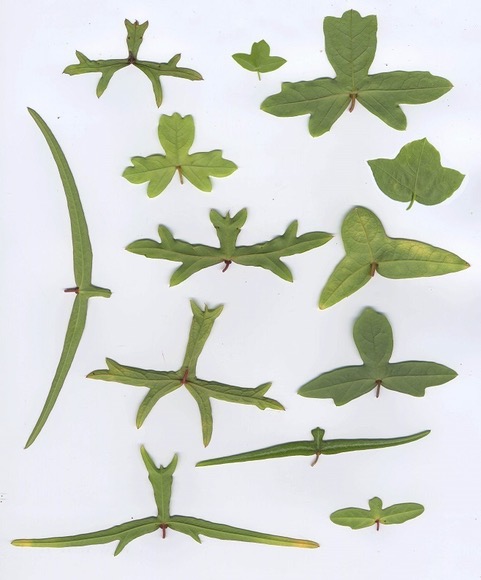
The hardest-to-find small Passiflora vine is the Birdwing or Slender-lobe Passionflower (Passiflora tenuiloba). Growing on open limestone areas with dry, caliche soils, often over boulders or tree stumps mainly in the Edwards Plateau to South and West Texas, this vine can display quite a wide variety of leaf forms (compare the leaf shape the photo below with the one in the banner at the top of the post, for example).  While roughly symmetric, the alternate leaves are typically as wide as to usually wider than long, 3 to 9 lobed, and resemble the outline of a bird with spread wings. Its small, intricate blooms are 0.75 inches across, greenish-yellow with yellow fringelike segments that can be purple at the base.  Flowers can appear from April to December, turning into 0.35 inch wide dark blue to black berries.

Birdwing Passionvine

Birdwing Passionvine Leaf Variation 
©Doug Goldman, 2001, Cornell University

Most Passiflora species are host plants for longwing and fritillary (Heliconian) butterflies, such as the more common Gulf Fritillary and Variegated Fritillary, as well as the less common Zebra Heliconian and Julia Heliconian.  The larvae of these species feed on passionvines, and chemicals from these plants make the adults noxious to predators. 

The naming of the Passiflora genus of plants comes from the description of their intricate flower parts in the early 17thcentury by Spanish priests.  Known by the Spanish as La Flor de las Cincos Llagas or ‘The Flower with Five Wounds’, the passion flower refers to Christ’s suffering and its parts represent various elements of the crucifixion. The five petals and five sepals are the ten disciples less Judas and Peter, the corona filaments are the crown of thorns, the five stamens with anthers are the five sacred wounds, and the three stigmas are the nails by which Christ was bound to the cross.  While this symbolism is not universal, it is still an important reminder today in Christian societies throughout the world.